Chess puzzle: Win faster (easy)

Once again my newly gained endgame powers saved a game in which I messed up the middle game. Thank you, Josh Waitzkin! Great tutorial. I played the whole endgame through the 10 second Fisher time, since I was already down to 4 minutes at move 35.


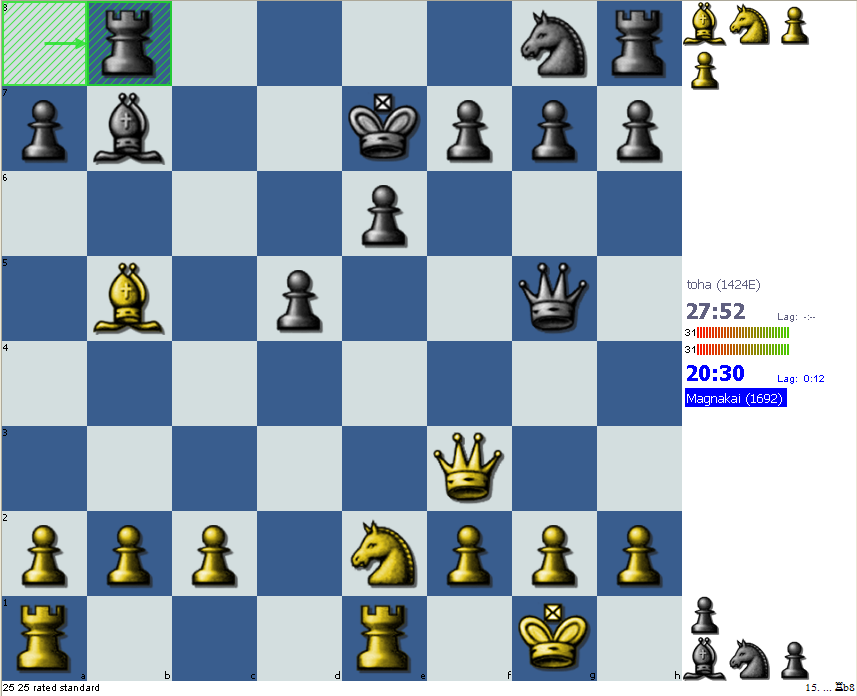
At the latest after my move 52 it is obvious that I am winning. But there is a better way. After 52. …Bxc7, how could I (white) have gained a queen faster?

Monday, August 4th, 2008 Chess No Comments

Chess puzzle #16 (easy)

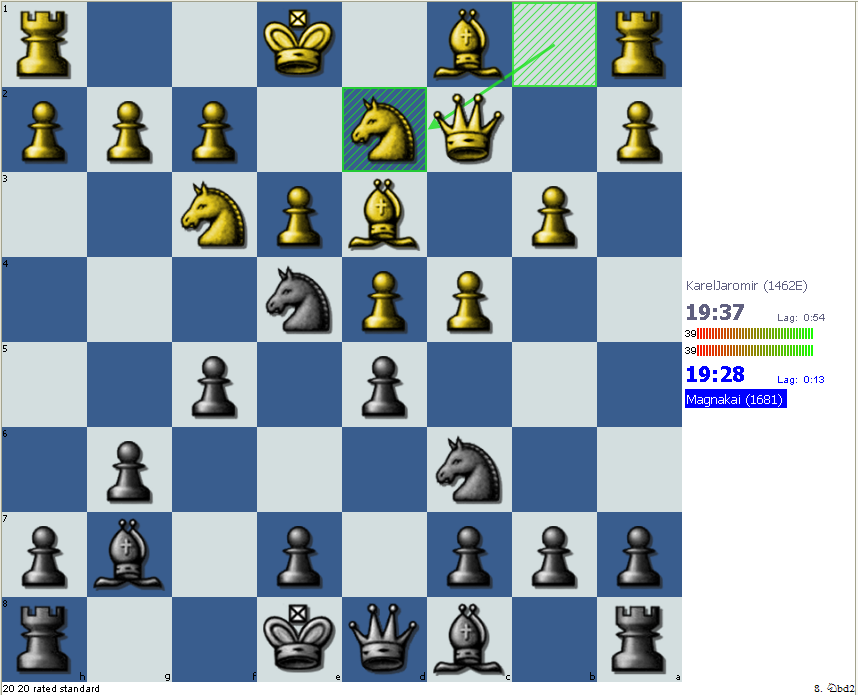
I (white) set up a trap here.

White threatens trap

White threatens trap


Question 1. What’s the threat against black? show
Question 2. Black to move. Get out with even material. show

Saturday, August 2nd, 2008 Chess No Comments

uCertify review

Recently the PR department of uCertify approached me and asked me to blog a review about their exam preparation kit. Since this is an interesting topic to me (see my posts Whizlabs vs. Enthuware, and Effective Enthuware) and since I would get a free simulator, I agreed.

uCertify produces preparation kits for many different IT certifications, including SCJA, SCJP, SCJD, SCWCD, SCBCD, SCMAD and SCDJWS. I got the one for SCBCD 5.0 (Sun Certified Business Component Developer for the Java Platform, Enterprise Edition 5, CX-310-091), which costs USD 59.99, to test it. I used the uCertify PrepEngine Version No: 12.21.05.

Strengths

  • A nice looking user interface with good usability, especially regarding all the little things. For example it is possible to click on the answer itself, not only on the checkbox next to it. Several keyboard shortcuts are available.
  • It has an optional study mode for every kind of test. When enabled, it says immediately which answers were wrong, rather than evaluate all answers only after they have been given. This provides a more harmonic way of learning and measuring progress.
  • It automatically shuffles the order of the answers. That’s an awesome feature that I miss in Enthuware and Whizlabs! It prevents me from remembering the position of the right answer instead of really learning the right answer.
  • The explanations to answers are good and include diagrams where it makes sense.
  • Huge amounts of study material are included! It is not only a simulator, it is a full preparation kit, just as promised.
  • Aside from the option to study the topics using small articles in the style “What is the PreDestroy method?” and larger articles about complex topics, there is an interactive mentor that almost provides the feeling of having a real private teacher. In small chunks it presents the exam topic as specified by Sun, then explains it, and afterwards asks me a question about it to check whether I understood it.
  • There is a feature to discuss any single question with others, similar to a forum thread. Once there are more users this can be very useful. I tried it a few times, and it took more than a day to get my comments “approved”. Hope that gets better.
  • Questions can be assigned a custom tag. For example I can give several questions the tag “unsure” or “do again before exam” and then create a custom test based on the tag. I would highly recommend to use this feature to assign box IDs according to the Leitner System, similar to how I described it for Enthuware in Effective Enthuware. (Note that numbers and short names are problematic, so use for example “bbbb” for box 2.)

    uCertify custom test screen

  • There are lots of features which I didn’t cover in this review, because there are so many. I covered the ones I considered important to my way of learning, but one of the other ones might just be the feature you always wanted.
  • Question quality and exam topic coverage: I trained for a section using Enthuware until I was able to answer all questions in Enthuware corectly. After that I tried questions for the same topic in the uCertify simulator. I passed on the first try, but there were some exam-relevant topics that had not been covered enough in Enthuware! (Concrete example: It is possible to get through the Enthuware questions without fully understanding MEMBER [OF] in JPQL. uCertify did not let me get away with that.) Nothing against Enthuware - it is possible that this test would have worked the other way round in the same way. Simulators have different strengths and weaknesses.

Weaknesses

  • It doesn’t have a direct way of selecting a range of questions. For example I can’t easily create a test with questions 1 - 6 of topic X and later questions 7 - 12 of topic X. (To do that, I have to add all questions to the pool, sort by ID, then delete some of them, remember which ones I deleted, do the others later.)
  • Support. I used the general support, not the one for paying customers, because I am not really a paying customer. My questions were answered only partially sometimes, and one of three support requests was ignored completely. Let’s just hope they provide better support for normal customers.
  • The license is complicated. I asked the support about it, but still don’t understand if I can install the product years later on different hardware. An on-line activation is required. I wouldn’t recommend buying it if you are planning to use it for longer than a year, unless you sort this out.
  • Getting the custom tags, an important feature (see above), to work was a challenge. First I tried tags like “1″, or “2″, and they just didn’t show up in the custom test dialogue. Then I tried “a” and “b”, still no success. So I tried “11111″ (maybe it’s a length issue?). Then it showed up, but when I tried to add the questions with that tag, only two or three, it added more than 100 to the question pool. In brief, my impression is that there are certain rules for tags: 1. At least 3 or 4 chars; 2. no numbers (or not only numbers?).
  • Portability - requires Windows. Maybe one of the thin emulators like Wine can handle it? VMware certainly can.
  • The integrated help is a single, huge page.

Conclusion

uCertify provides more than Enthuware or Whizlabs. I cannot answer the very important question of which simulator provides the most relevant questions regarding the real exam, and if someone who uses the complete preparation kit of uCertify will get a better result in the real exam than a low budget learner with Enthuware plus free study material. More fun with uCertify - well, that’s indeed possible due to the nice user interface and the interactive mentor. The complicated license and poor support are a problem.

Register to get a 10 % discount on any uCertify PrepKit.

Friday, July 25th, 2008 Computers 4 Comments

Learning chess with the computer

Introduction

I am not a very good chess player, although I have played for 25 years. My FICS rating is below 1800. So you may first consider a chess learning guide by someone more experienced. This guide might still help when you want the opinion of someone in the same class.

One thing I have been planning for over 10 years is to improve my chess skills by a whole level. This year I did, and I was stunned by the great new ways that computers and the internet offer for beginners and intermediate players to learn, compared to what I had in the 80s.

Interactive Tutorials

I found it far more effective to use an interactive tutorial than to read a book. A good interactive tutorial asks questions, like tiny exercises, which force the reader to do something on the board. The additional gain compared to reading a traditional chess book is huge. The solutions that are out there do not fulfil all my dreams, but they are quite nice.
Chessmaster explains about forks

  • Chessmaster Grandmaster Edition has many tutorials. The most helpful one for me was the one by Josh Waitzkin. It taught me not only the direct chess strategies I needed to get to the next level, but also to express myself with chess as a form of art and to develop my character and my personality along with my chess skills. Chessmaster Grandmaster Edition is very affordable, but hard to get in some countries.
    One of Chessmaster\'s interactive tutorials
  • The interactive mentor at chess.com is also available as stand alone software at http://www.chessmentor.com/. Either are very expensive (the web version is a subscription with a monthly fee). Another weakness is that it doesn’t have many features compared to Chessmaster. It is a very primitive software. For example most moves are not shown on the board and are just there to read in PGN, so I end up having a hard time following it, similar to reading a book. But the lessons have a high degree of interactivity and are of a very high quality. Especially regarding positional play and middle game strategy it covers many things that Chessmaster doesn’t cover well, and it does so at a very high level. Most lessons have been created by the renowned IM Jeremy Silman. All lessons require to be solved on the board by making a particular series of moves. When the user makes a “wrong” move it sometimes is explained very well why it is wrong or that it is fine, too, but in some cases it isn’t. But it is impressive how many possible answers are covered and properly commented. Anyway, that’s basically all it does. That’s about 3 % of the features Chessmaster has to offer. But really, great quality, very valuable information.

Post-game computer analysis

This is such an incredible help! After I played a game (against a computer or against a human) I always feed it to a computer and get an incredibly useful analysis. It comments on my moves, finds all tactical blunders and so on. You can’t imagine how much this has helped me to get better! While it doesn’t miss any tactical opportunity, it is no help for strategy at all. That would require a human mentor to look at my games. The next best thing are probably the positional and strategy lessons of Chess Mentor (see above). They present a position in the late opening or middle game and then require to find a good strategy to be provided by a sequence of moves.

  • Chessmaster Grandmaster Edition can analyse any game in PGN format with short algebraic notation.

    Pro: It has audio output and comments on more aspects than any other analysis software I tried. For example when I do a particular unusual opening move it says something like: “Ah, interesting. That’s the Steinitz Attack. Some guy named … has used it around 18.. with great success. It became less popular when …d6 has been discovered. After that move white has no advantage left from this move. (…)” Such facts become very interesting when they refer to a game I just played, as boring as they would otherwise be! Another advantage is that it directly says why my move is not good.

    Contra: It is inconvenient to browse the move alternatives slowly and manually and to try additional variations.
    Chessmaster analyses a game

  • Common chess engines like Crafty can be plugged into a fool-proof frontend like BabasChess.

    Pro: Great navigation options to browse the suggested alternatives, very easy to let the computer answer “but…” and “what if” and “but what if …” questions regarding its own suggestions or anything at all, actually. Chessmaster Grandmaster Edition might leave you alone with troubling thoughts like “I don’t have a good feeling about the alternative it suggested. It only works because black plays along in move x.” while the combination of a chess engine and such a frontend will easily show any subvariation you can think of. It’s like a neural interface.

    Contra: The output follows a primitive scheme, while in Chessmaster Grandmaster Edition you have the feeling of being mentored by an AI from the future. No comments on opening moves at all, and no explanations like “this is a better move because it pins the black knight to the black queen”, which Chessmaster can provide.

Game explorers

When studying openings I found it very disturbing that often the main line could easily be disrupted by a move that looks far greater. The books don’t say anything about such variations. There are many, many moves in the openings and early middle games that look great, and it is very hard to find out why they are not great and what to do if someone plays them. Game explorers help to see what grandmasters played against an unusual, but not entirely far-fetched move. They are great to learn a particular class of opening moves or repeating early middle game lines. When I read a book back in the 80s it always left me alone with thoughts like “But that will never work when black does …” and then when I tried it black does exactly that, and I was still helpless and would better not even have started to read about it.

  • chess.com has a good one, but it is not free
  • Red Hot Pawn has a free one, but there are not enough professional games in the data base to make it really useful
Sunday, July 20th, 2008 Chess No Comments

Chess puzzle #15 (medium)

I didn’t see the opportunity. Do you? Black to move and win material.
Chess puzzle #15

Saturday, July 19th, 2008 Chess No Comments

Glassfish: WebService in Session EJB

I just got the strangest error message when trying to use a stateless session EJB as a WebService in Glassfish v2 u1:

[#2008-07-13T16:41:25.366+0200SEVEREsun-appserver-pe9.0javax.enterprise.system.tools.deployment_ThreadID=12_ThreadName=Thread-31_RequestID=d816d64c-543d-47ac-b339-2231f346754eException occured in J2EEC Phase
com.sun.enterprise.deployment.backend.IASDeploymentException
	at com.sun.enterprise.webservice.WsUtil.runWsGen(WsUtil.java:1817)
	at com.sun.enterprise.webservice.WsUtil.genWSInfo(WsUtil.java:2089)
	at com.sun.enterprise.deployment.backend.AppDeployerBase.loadDescriptors(AppDeployerBase.java:328)
	at com.sun.enterprise.deployment.backend.AppDeployer.deploy(AppDeployer.java:200)
	at com.sun.enterprise.deployment.backend.AppDeployer.doRequestFinish(AppDeployer.java:129)
	at com.sun.enterprise.deployment.phasing.J2EECPhase.runPhase(J2EECPhase.java:169)
	at com.sun.enterprise.deployment.phasing.DeploymentPhase.executePhase(DeploymentPhase.java:95)
	at com.sun.enterprise.deployment.phasing.PEDeploymentService.executePhases(PEDeploymentService.java:871)
	at com.sun.enterprise.deployment.phasing.PEDeploymentService.deploy(PEDeploymentService.java:266)
	at com.sun.enterprise.deployment.phasing.PEDeploymentService.deploy(PEDeploymentService.java:739)
	at com.sun.enterprise.management.deploy.DeployThread.deploy(DeployThread.java:174)
	at com.sun.enterprise.management.deploy.DeployThread.run(DeployThread.java:210)
#]

Apparently there is a problem in this Glassfish version that prevents it from showing the proper Exception as JAX-WS reports it. The verifier only barfed random shit at me, too.

I updated to the lastest Glassfish to get a better error message, but then it even worked without an error. Strange days.

Sunday, July 13th, 2008 Computers No Comments

VMWare asynchronous TSCs on Opteron

A rare VMWare error message is this one, occuring when the virtual machine is being launched:
Your host does not have synchronized TSCs. Please read VMware Knowledge Base article 2041.

Your host does not have synchronized TSCs. Please read VMware Knowledge Base article 2041.

When that error message pops up it is likely that all sorts of time-related things will go wrong in the guest system: Video playback, audio for the video, double-clicks.

An example environment where this can occur:

  • Host system Windows XP
  • CPU AMD Opteron for socket 939 (175, 180, 185, 190)
  • Certain drivers, such as those installed by MSI Live Monitor (AMD CPU Driver 1.3.2.16?)

Fix

I fixed the problem by adding these lines on the bottom of the .vmx file:

processor0.use = TRUE
processor1.use = FALSE
host.noTSC = "TRUE"
ptsc.noTSC = "TRUE"
host.TSC.noForceSync = "TRUE"

That way the guest system only has a single core CPU and only one core of the Opteron helps to emulate it, but that seems to be the only disadvantage.

Saturday, July 5th, 2008 Computers No Comments

Whizlabs vs. Enthuware

I bought several exam simulators for mock exams:

  • The one for SCJP 5.0 (CX-310-055) from Whizlabs
  • The one for SCWCD 1.4 (CX-310-081) from Whizlabs
  • The one for SCBCD 1.3 (CX-310-090) from Whizlabs
  • The one for SCDJWS (CX-310-220) from Whizlabs
  • The one for SCEA (CX-310-051) from Whizlabs
  • More recently: The one for SCBCD 5.0 from Enthuware

License

Enthuware uses a pretty normal end user software license, while Whizlabs plagues the user with a complicated activation procedure, only to limit the use to three CPUs! So when the user upgrades the CPU or gets a new computer, the license is lost. The three CPUs for which it works have to be chosen within 6 months after the purchase. That makes it pretty much useless for what I bought it, which is to keep my knowledge about topics that I currently don’t need at work up to date. Whizlabs simulators cannot be used for that. This is not much of an issue when the user wants to learn for a certificate and will never need the simulator again afterwards.

Learning process, repetition scheme

Whizlabs simulators have certain features which try to adept to the user (”adaptive testing”). As far as I know they do not follow proven methods from the field of education science, though.

Enthuware’s direct support for such features is limited. However, its comment system provides great flexibility for custom systems. My article Effective Enthuware describes how to use the Leitner System in the Enthuware Test Studio. That is the system for this type of learning.

Supported Platforms

Enthuware Test Studio requires JRE 5.0. The Whizlabs simulators support all common Microsoft Windows versions.

Errata

Enthuware Test Studio provides a direct link to the Enthuware forum post in which that question is being discussed. That can be helpful to find out if the proposed answer is incorrect, but recently I was usually the first one to check that out, so there were no other comments about that question.

Useability

Whizlabs has a Flash based GUI. It works well, but most things must be done with the mouse.
Enthuware uses the common key and mouse bindings for GUIs (Swing with system’s default L&F).

Price

For most exams the Whizlabs products are a little more expensive than the Enthuware products. For example Whizlabs SCBCD 5.0 Preparation Kit for USD 74.95, Enthuware EJB+ Full Version for USD 29.00.

Question Quality

The big unknown. I do not know anything about a conclusive study regarding the question qualities. They are both at least okay.

Question Quantity

Untransparent for Whizlabs products, and varies from product to product.

Conclusion

I recommend the Enthuware products. The knock-out arguments are the license and the Leitner System support. A really nice objective test from a huge organisation would help, like the tests we have for cars and such, a test which would also examine question quality and study time / exam result ratio. But this market is just too small, so you have to do with subjective reports like mine.

See also the Effective Enthuware article.

Tags: , , , , , , , , , , ,

Friday, July 4th, 2008 Computers 3 Comments

Chess puzzle #3 (medium)

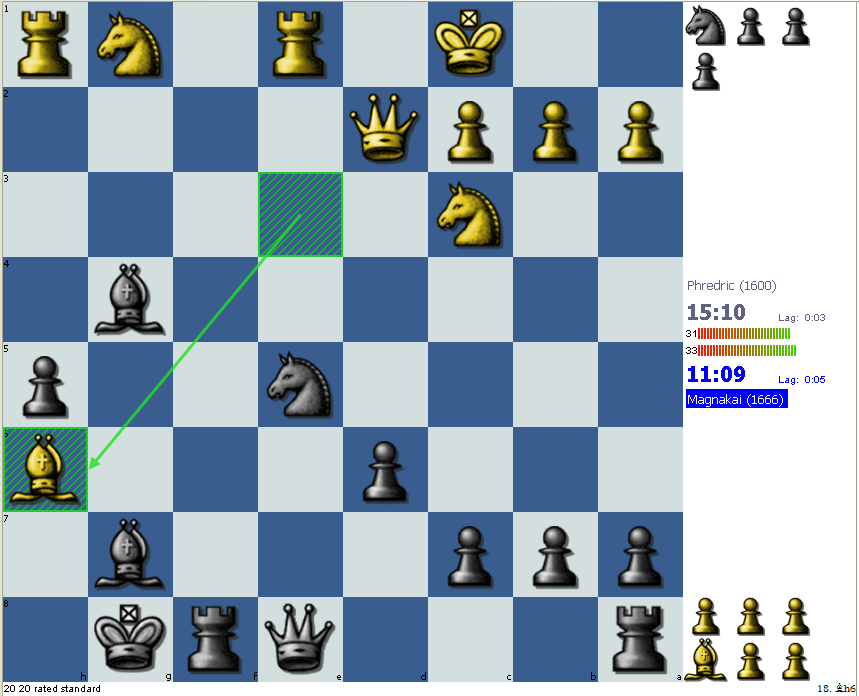
I (black) felt that there was a way to get out of this alive and with even material, after I accepted the sacrifice of Chessmaster Grandmaster Edition (white) and ended up in this situation. So I used up all my time to think myself out of it … and still failed.

Do you see a way out? It is possible.

Solution: show

Wednesday, July 2nd, 2008 Chess No Comments

Chess puzzle #9 (easy)

Black to move and win significant material.

Monday, June 30th, 2008 Chess No Comments